Monday, June 15, 2015

THE LITTLE DEATH

You could be forgiven for thinking from the opening scenes of this new comedy from Australian actor turned director Josh Lawson that you are about to watch a movie that is like a Wikipedia of sexual practices, or even some soft-core pornography. Thankfully it is neither of those although Mr. Lawson does want us to laugh at the absurdity of fulfilling sexual fantasies, which never ever turn out like you had dreamed and wished for.

These then are the totally separate stories of five couples and the tenuous link to them is the fact that they all live in the same suburb neighborhood, and they are all white and middle-class. The first concerns Maeve who confides to Paul her live-in boyfriend that she has a rape fantasy, which he is as reluctant to comply with as he is with proposing marriage.  Evie and Dan’s marriage has hit a rocky patchy so the Counselor they consult suggest role-playing to spice things up a bit.  The trouble is that Dan gets so into it he quickly forgets why the started doing this as he is now completely obsessed with becoming an actor so he can play dress-up every day.

Richard and Rowena have been trying to have a baby for so long that sex has become a monotonous chore, for Rowena anyway. That is until her husband gets really bad news and bursts into tears and she suddenly discovers she has dacryphilia (that thankfully is explained on screen).  It means that she gets sexually aroused at the sight of tears, which is harmless enough until she finds has to plot to constantly keep Richard sad enough to weep whenever she fancies getting laid.  It is an odd condition, but not quite as potentially objectionable as the somnophilia that Paul has when he drugs his nagging wife Maureen so that when she is passed out, he can finally have sex with her.

The fifth and final … and by far the best scenario …. is of a couple of strangers who have not met in person. Monica works as a signing translator for deaf people wanting to make phone calls, and one night Sam calls into use the service.  He wants to be connected to a sex line and poor Monica has to be the conduit for the funny and bawdy language that passes between the ‘working girl’ and Sam a cute young graphic novelist.  Despite it’s set up it has the most tenderness of all of the scenarios because of the very real chemistry between both the caller and the operator, and it is such a genuine connection. 

There is one other tenuous link between this group of vignettes in the shape of a new neighbor who is going around introducing himself. Whilst handing over welcoming gifts he slips into the conversation that fact that he is a Registered Sex Offender, but every household he calls on is so wrapped up in their own problems that the last part simply doesn’t sink in.  Just when you think he may get back to his old ways, Lawson finishes him off.  We had expected something fatal to happen because of the title (changed in the UK to ‘A Funny Kind of Love’) and he is one of the ‘little deaths’.

The movie ends up being more bizarre than bawdy although it does heavily on the basic assumption that many people who find sex funny will find this movie comical too.  The troubles are that the laughs are rather intermittent and some regarding the whole concept of non-consensual intercourse are bordering on being offensive and in extremely bad taste.

As well as giving himself a plum part (Paul) Lawson does pepper the piece with an extremely talented cast of well-know Australian actors.  Particular mention to the pitch performances from TJ Power and newcomer Erin James as Sam and Monica. By placing their story last in the proceedings it did at least mean the movie ends on a much higher note than the one it started on.

★★★★★★★

Friday, June 12, 2015

ACTRESS

Brandy Burre is a character actress .... or rather was one when she appeared in the third and fourth season of HBO's The Wire some eight years ago. Now she is a housewife and the mother of two small children living quite a comfortable existence in suburban Beacon in upstate New York with her restaurateur boyfriend Tim.   This new film on her life now can hardly be called a fly-on-the-wall documentary however as Burre, ever the actress, cannot help but play up to the camera at times when she sees to forget that this is actually her real life and is not just yet another role that she has been cast to play. 

Shot (and edited) by Robert Greene, who also happens to be Burre's next door neighbor and friend. it focuses on her desire to get back to work.  Sitting on a beanbag in the children's room on her own sorting out their toys she sighs out loud 'I'm not acting, so this is my creative outlet, I guess'.  She does in fact get some gigs singing with a band, and is also seen discussing potential work on the phone, but neither of these things lead to anything else.

Filmed making rather a drama out of simple daily domestic tasks, Burre also uses her two infant children as her audience when she openly discusses life with them as if they are adults.  She is faced with little choice as Tim steers clear of the filming, and finally from her when he  chooses to move out.  She talks through this all out loud on camera rather melodramatically and although she avoids explaining the reason for his decision, it is apparent that he had discovered that she has been unfaithful. She nevertheless uses his silence to cry 'pity me 'into the camera as she is determined to be the martyr of the piece. 

Despite Greene's brave attempt to paint a flattering portrait of someone who has 'suffered' by giving up her 'art' to be an unselfish mother and spouse he completely fails as there no real evidence that her career was the unqualified success that she recalls to anyone like her hairdresser who is forced to listen. At the same time Burre fails to disguise the basic fact that she is so completely self-centered and unquestionable selfish, qualities that seem to be essential requisites in her eyes to return to acting again.

Greene makes uncomfortable voyeurs of us all particularly because he fails to make us like Burre at all.  He finishes the movie with no real conclusion as to what Burre's future will actually turn out to be , but you do get this real sense, even in his small bachelor apartment on his own, that Tim at least is so much better off now.

★★★★★


Thursday, June 11, 2015

SHE'S THE BEST THING IN IT

Veteran character actor Mary Louise Wilson starts this affectionate portrait on her life with what she claims are the five basic stages of acting:

1) Who is Mary Louise Wilson?
2) Get me Mary Louise Wilson?
3) Get me a Mary Louise Wilson type;
4) Get me a young Mary Louise Wilson.
5) Who was Mary Louise Wilson?

The Tony Award winner is disarmingly honest about the ups and downs of her long career, which has now brought her at the age of 79 leaving New York after 60 years to go back to New Orleans to teach her first acting class.  Winning a Tony for her performance in ‘Grey Gardens’ in a role that had been specifically written for her had been a curse. Since then the phone had stopped ringing with any offers as Broadway producers assume that as a character actor she would now be too expensive, but even that doesn’t seem to suppress her good-natured humor or make the twinkle in her eye disappear.

Mary Louise is however a rather rare bird in her profession having hated her stint in Hollywood playing in lucrative television sitcoms and hot-footing it out of there when she got too miserable.  She found solace in the theater, plus drinking half a bottle of wine every night, and getting married.  The latter to an actor who landed a role on Broadway in Man Of La Mancha. ‘I saw the Show and said this is a bomb, but it lasted longer than our two year marriage.’  She admitted finding her sobriety 18 years ago, but refused to talk any more about any other likely romance.

Then at the age of 69, Mary Louise and Mark Hampton wrote ‘Full Gallop’ a one-woman play about fashion doyenne Diana Vreeland that garnered her several awards and a major boost to her career. It also led to her Tony Nominated performance in Cabaret two years later.

Now back in New Orleans, even though the acting classes take a while to really kick in, when they do it is obvious that Mary Louise not only is in seventh heaven surrounded by all these 20 year old students, but that she has a real flair for infusing them with her energy, enthusiasm and her well-crafted acting techniques.  As teacher and pupils bond, Mary Louise appreciates that she is really well suited for the role even though she may have arrived more at it initially by fault than design.

This first feature documentary directed by Ron Nyswaner (Oscar-nominated Writer/Producer 'The Philadelphia Story') also asks other female actors for their take on their profession including Melissa Leo, Estella Parsons, Charlotte Rae and Valerie Harper. The best quote however comes from Frances McDormand who simply described her own very successful career as ‘I have been supporting male protagonists in movies and television and plays for 30 years and so you kind of end up being a character actor by default sometimes.’

The movie is at best uneven and because one cannot help but be so charmed by Mary Louise, you simply knows that she deserves a better profile than this. Hers may not be a name that is instantly recognized by every theatergoer or movie/TV watcher, but the instant you catch sight of her, you remember exactly where you saw her in a performance that you admired and probably really loved.

The title of the documentary is explained at the end. Having recently lost her sister, after losing her gay brother to AIDS some decades ago, Mary Louise is visiting the cemetery where her family is buried to reveal that she already has her own tombstone ready for the day she joins them.  It simply reads 'Mary Louise Wilson : She Was The Best Thing In It.'

★★★★★★★★


She's The Best Thing In It Trailer from She's The Best Thing In It on Vimeo.

Wednesday, June 10, 2015

BROOKLYN

Home maybe where the heart is but in the early 1950's in rural Ireland with work so scarce, this is a luxury that few young people can afford. Twenty-something-year-old Eilis can only find herself a two hour stint on a Sunday after Mass behind the counter of the village Provisions Store run by Miss Kelly, the local scrooge. So the Church pulls some strings for her and arranges a passage to Brooklyn which is packed full of Irish immigrants, and as it includes a place to stay and a job,  it is an offer that Eilis reluctantly accepts .

She ends up in a small boarding house for working girls run by a strict and opinionated Mrs Kehoe (played hilariously by scene-stealing Julie Walters). Eilis's job is as a sales clerk in a rather grand department store where she feels like a fish out of water and very alienated. The only person she knows is the local Parish Priest who is also from her home town of Enniscorthy, County Wexford, and it is he that gets her out of her depression by suggesting she attend night school classes to learn accounting to qualify for a better job.


Father Flood also encourages her to go with the other girls from the Boarding House to the very tame Saturday Dance to meet people. And she does just that ... his name is Tony and he is a very affable handsome Italian plumber who has penchant for pretty Irish girls. He is not nearly as bright and articulate as Eilis but he is not only charming and kind, he is also obviously very quickly totally smitten. When their relationship starts to get serious he suggests taking Eilis to meet his large family which she only accepts once she has taken some private lessons from one of the other girls at Mrs Kehoe's on how to eat pasta for the first time without making a mess. She need not have worried as the meal is a big success, even though Tony's much younger brother suddenly blurts out that Italians don't like the Irish.

This Italian does however and when Eilis gets the shocking news that her sister Rose has died and she decides to go home to be with her mother, Tony persuades her to marry him to be sure that she will return.  After a night of passion, they slip in to City Hall and get wed without telling a single soul, and then Eilis sets sail for Ireland.

Once home everyone simply assumes that as she is single that she is back for good and her best friend Nancy, who is about to get married, literally throws Eilis into the arms of Jim the most eligible bachelor in the whole County. She is even offered her sister's old well paid job as a bookkeeper. Weeks pass and Eilis is really conflicted as she loves back being in the wide open countryside that she knows so well, and her widowed mother now only has her for company too. She is on the verge of discarding her old life in the New World to start a new one in the old world when Miss Kelly her vindictive old employer tries to cause some mischief which backfires, but it inadvertently sets a determined course for Eilis once and for all.

This enchanting  drama is directed rather lovingly by Irish theater director turned filmmaker John Crowley from a script from Oscar-nominated Brit writer Nick Hornby ('An Education') based on the best selling novel by Colm Toibin who was himself a native of Enniscorthy.  The attention to detail is flawless. Period dramas are a genre that indie movies usually avoid as they are generally too expensive to mount. However what is particular engaging in this instance is that as well portraying the era of mass emigration so perfectly, it more importantly captures the genuine angst that young Eilis dealt with by being torn between life and love in these two such different changing worlds.

Superb performances from a very impressive cast led by Saoirse Ronan in her first 'grown-up' role who simply shines as the young country Irish lass who loses her innocence and finds love,  and Emory Cohen who is pitch perfect as the shy simple plumber who courted her with such charm and politeness.  There is a point when Eilis is still reluctant to respond to Tony's advances and she confides to one of more worldly boarders at Mrs Kehoe's.  'Does he just talk about baseball and his mother?' she is asked. 'No, not at all.''Then grab him, he's a very rare Italian.'

It's a rare movie that will be not just a big popular crowd pleaser but also one that is bound to gather more than it's fair share of Awards.

★★★★★★★★★

Monday, June 8, 2015

A LITTLE CHAOS

Poor Monsieur Le Notre.  The King is giving him a hard time to design the most perfect gardens in the world and within budget, and at the same his feckless wife is playing fast and loose with every young man she can afford to pay for her carnal pleasure.  Then to top it all the best plans submitted to him for a outdoor ballroom are designed by a woman!

The year is 1962, and Louis XIV known as the Sun King is building his extravagant Palace at Versailles in which he is planning to move his entire Court from Paris. The King is getting anxious as the whole project has taken years and he is definitely running out of patience, and maybe money too.  Le Notre his chief landscape architect is under pressure to ensure that 'Heaven shall be there' as decreed, so taking a gamble he rejects all the presentations from the country's leading male landscapers, and settles on the scheme of the totally unknown Madame de Barra.

Madame is a young (ish) widow and has a sad back story to justify why she is trying to hold down a job in this man's world. At first things are frosty between her and the broody Le Notre who is a man of few words at best, but soon he very slowly reveals that he has designs on her body and as well as her body of her work.  When Madame Le Notre discovers this even though she has no hope of winning her husband's affection back, she is determined that Madame de Barra doesn't get them either, so she plots to put a dampener on their budding relationship.  Literally.

Meanwhile the common born Madame de Barra is like a fish out water amidst the scheming superficial and over-dressed aristocratic courtesans but in an accidental meeting she attracts the attention of the King. He is alone and grieving for his recently deceased Queen, but is quickly captivated by the straight-talking Madame de Barra which sets the seal of approval for her new garden, even though it really was never in any doubt.

The trouble with this well-meaning lavishly produced French costume drama is that it all seemed so frightfully English.  Shot in the English countryside with a totally English cast (save for a lone Belgian and one American) and with an English (and Irish) scriptwriter and director too, there was barely a hint of anything 'francais'. 

Starring Kate Winslet who as usual puts in a stunning performance as the tough single-minded Sabina de Barra and she doesn't even wince once when she has to churn out some lines that are much more suited to a contemporary soap-opera e.g. describing La Notre 'He is the most complete person I know.'

Co-starring with her is Matthias Schoenearts who seemed totally stunned at times as he played her erstwhile lover with almost a complete lack of emotion, unlike Stanley Tucci playing the King's bisexual brother who just camped his way up through the whole thing. Louis was played by Alan Rickman who was also behind the camera for a second time (the first being 'A Winters Guest' back in 1997) and he gave himself one of the best scenes in the movie with his surprise encounter with Madam de Barra in the garden. 

The oddest thing was at the end of this two hour long drama with all it's hype of what an excellent gardener Madam de Barra was, there was barely a single plant to be seen in her finished project.  A tad disconceting and disappointing, a little like the whole movie itself. 

★★★★★★

Friday, June 5, 2015

THE SALT OF THE EARTH

Wim Wender's Oscar nominated profile on the Brazilian social documentary photographer and photojournalist Sebastião Salgado is one of the most illuminating and deeply moving portraits of an artist to hit the screen in a very long time. Co-directed by Salgado's son Juliano Ribeiro it focuses on the celebrated photographer's extraordinary body of work with its powerful images that make the scant commentary that Wender provides at times complete superfluous.

It opens with Salgado's most recognized images from the Sierra Palada mine that were part of his 'Worker' series of the 1980's. They set the pace for some extraordinary breathtaking photographs that will haunt you for the next couple of hours, and remain with you long after that.  Like so many of the projects Salgado chooses to record, the sheer scale of the extremes that humanity go to survive are for the most part incomprehensible to accept and understand.  In this particular instance this multitude of miners are risking their lives for the possibility of riches, but when it comes to the projects that he covered with Doctors without Borders, the only focus of the subjects he captures with his lens are simply to stay alive against all the impossible odds.

'The Sabel: the End of the Road'  project was Salgado's first major exploration of whole communities suffering from deprivation.  He followed that with 'Exodus' which was a record of the misplacement of several populations through famine and war, concluding with the atrocities of the civil war in Rwanda.  This, he related on camera, left him psychologically scarred by the what he witnessed, but his words were unnecessary as we could see his pain in the devastating images that he photographed at the time.

Throughout his life since his political views made him and Leila, his wife and collaborator, flee their native Brazil because of their political views, Salgado has left his family for years at time to follow his passions. They were to capture humanity often at its worst and compile a remarkable record of some of the world's most violent scenes of misery of the past few decades. Wender notes that some critics such as Susan Sontag have accused Salgado of making his work into aestheticized objects for Western consumption but they are simply misreading and unnecessary over -intellectualising the fact that as an artist (and a really superb one at that) he just cannot fail to bring a strength and even a dignity to even the most harrowing of subjects.

Watching the movie wind its way through Salgado's whole body of work is in itself an intense experience and in Wenders he has found the most perfect soul mate to help share his experiences. Wenders adds some brilliant touches such as photographing the photographer and blending Salgado's own image with that of the photograph he is discussing at the time which adds such an intensity.

When the Salgados happily returned to Brazil after the eventual change of government they find  his aged parents still living on the family farm that has been ravaged by the both the droughts and the wholesale destruction of the rain forests.  When they first mention their plans to restore it all back to how it was original decades ago by planting over a million trees it seems that this scheme is so ludicrously extreme that it can only be a wild fantasy.  By then however. Wenders has made us appreciate the extraordinary commitment and selfless determination of Salgado, and equally important of Leila too, that it comes as no real surprise that they succeed in this ridiculous plan which eventually extends far beyond their own lands now.

Salgardo says at one point 'We are a ferocious animal. We humans are terrible animals. Our history is a history of wars. It's an endless story, a tale of madness.'  By choosing to finish the documentary with the creation of Instituto Terra, Wender does at least a positive footnote to end on as after all man's inhumanity to man that Salgado has focused on so far, it gives us some hope that all is not totally lost.  

A worthy winner of three Awards at the Cannes Film Festival and a César from the French Film Academy, it is the perfect portrait of a remarkable artist and an exceptional human being.

★★★★★★★★★★

Wednesday, June 3, 2015

FELIX AND MEIRA

This unexpected and unconventional love story starts off with the most random of encounters when Felix a perpetual womaniser cannot stop himself hitting up the sad looking attractive Hassidic woman waiting with her baby to pick up her food order in a delicatessen. There is no reaction from her at all or any real connection between the two of them and we assume that is the full sum of it.  Meira is a young wife trapped in her traditional Jewish marriage and although she is committed to her faith and actually likes her husband, she bitterly resents the fact that she is entrenched in a way of life in which she knows that she is not cut out for. Instead of being the obedient dutiful spouse who should be breeding a large family and settling down, she is surreptitiously taking birth control pills and having some fun on the side listening to the jazz and practising her art despite promising her frustrated husband that she would cease both.

Another chance meeting in the snow covered streets of the predominately Jewish quarter in Montreal where they both live, and Felix and Meira discover they have a common interest in art.  It will take them longer to realise that they are also both floundering wretchedly unhappy in their own different worlds. Whilst Meira struggles with wanting to be free and single, Felix already something of a drifter, has been unsettled by the unreconciled differences he had with his wealthy distant father who had just died.

Miera's husband annoyed at having to constantly explain her erratic behaviour to their community and anxious to try and control her, decides to 'banish' her to stay in Brooklyn with his female cousin and as a punishment, forbids her to take their only child along It is the final straw that actually pushes her into Felix's arms for up to now their very constrained friendship has been very circumspect even though there is obvious a much deeper and romantic connection between the two of them. 

Although this is a contemporary story there is very much an old-fashioned feeling to it all mainly due to the whole traditional lifestyle that Miera is part off, right down to the gentle ineffectual way her husband physically attacks Felix once he discovers the affair. The wintry setting of a rather cold and forbidding looking Mile End area adds to  the bleakness of their situations. It makes the whole concept of this originally unlikely seeming relationship become a reality when both of these two lonely souls sense the possibility that life need not be quite so empty. What may have started out simply as a diversion from their unhappy lives gradually evolves into a real romance once they both let their guards down and the chemistry kicks in.

The remarkable aspect is that this burgeoning relationship is portrayed in an almost chaste manner on screen, but there are some powerful intimate moments such as when Meira tries on some tight fitting jeans for the first time, or when Felix eventually gently takes off Meira's wig, which add such a fierce intensity. It is greatly helped by some remarkably compelling performances both from Hadas Yaron the young Israeli actress whose breakthrough role was as another Hassidic wife in the stunning 'Fill The Void' and also from Martin Dubreuil an experienced actor who is little known outside his native Canada (although this movie will change all that). The pair so convincingly capture the essence of these two unfulfilled strangers who finally discover some purpose and happiness in this forbidden friendship which turns into something far beyond what either had dreamed off.

Credit also to French-Canadian writer/director Maxime Giroux for among other things making Meira's abandoned husband such a accepting character that despite his bitterness/sadness at losing his wife showing that he genuinely loved he and truly wanted her to be happy even if in the end it meant leaving him.  It was a refreshing twist to the plot.

Felix & Meira is a very melancholic love story and even when the couple are finally together there is still this fine veil of sadness that never quite dissipates. It is though a really exquisite movie and utterly beautiful to watch evolve.

★★★★★★★★

Sunday, May 31, 2015

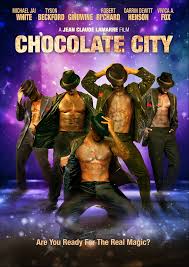
CHOCOLATE CITY

'Y'all seen Magic Mike right? Now we gonna add a little chocolate' intones Michael Jai White before the opening credits of the movie. What he fails to mention is that they have also added a lot more cheese and a great deal of soap too in this all-black take off of the 2012 smash hit movie about a group of hot male strippers. The story follows a similar vein about a regular guy who reluctantly becomes an exotic dancer to discover that in fact that this is his natural calling and overnight becomes a big star.

In this movie our man Michael is a Grade A student who has a part time job in a hamburger joint to help support his mother who has just had her job cut and his older brother who has an complete aversion to work. He wants to have a girlfriend and his heart goes aflutter every time he sits next to Carmen in class but she will not go out on a date with him as he doesn't have a car.

The family are about to have their power cut off when Michael is approached in the Men's Room of a Club and offered a job (!) which he ends up taking. Actually at first he turns it down flat, but his greedy brother seeing how much money can be made, eggs his sibling to get on stage and strip in front of a packed crowd of black women all waving wads of dollar bills in the air.

Strangely enough given the nature of the job he, and most of the other strippers, finish their acts with their trousers still intact, but there are many points like this in this poorly written movie that simply do not seem to ring true. Having said that, all of the stripper/dancers are amazingly sensuous and their sexy routines are one of the only things that is so much hotter than they were in 'Magic Mike'.

Now working late nights, Michael's school work suffers so within weeks his grades in his French class go from A to D but on the plus side as he now has a set of wheels he finally gets laid so he does at least get to use some french letters.

His church going mother worries about Michael's new found wealth as she and Carmen have no idea that he is getting it by just shaking his stuff for hoards of screaming ladies who cannot get enough of him.  His co-workers resent the fact that newbie Michael is promoted over them to get star billing and hence more money.  It is obvious though that it is all going to end in tears and quite quickly, although funny enough the two women in his life surprisingly take his eventual disclosure with no more than a mere bat of an eyelash.

Chocolate City is  cliched, packed full of stereotypes, and with such corny lines that you positively wince for the actors who have to trot them out. Like when Carmen asks why he kept the fact that this was the way he chose to get his family out of debt, Michael replies 'I'm a man.  I can't ask for help!' Writer/director Jean-Claude La Marre is a man too, and he so should have asked for help with this movie.

In fairness the target audience for this movie is young black  women and I am anything but that. Also as I am going for complete disclosure I will admit that I thought that 'Magic Mike' was just a piece of really bad sex-less soft-porn and saw no 'magic' in it at all. Chocolate City does at least have some good routines plus  Michael is played by Robert Ri'chard who does have the most amazing washboard abs, even though he is a good churchgoing boy who keeps telling his mum how much he loves her.

★★★★  

Saturday, May 30, 2015

FAR FROM THE MADDING CROWD

It’s hard to distinguish if some of the criticism leveled at this, the fourth adaption of Thomas Hardy’s fourth novel, is because the director of this English classic is Danish, or because ardent cinephiles are miffed that anyone should try surpassing John Schlesinger’s 1967 definitive version starring Julie Christie. Nevertheless this new pared down adaptation scores high with its take on the tale of how Miss Bathsheba Everdene discovers that her new found wealth makes her the most eligible spinster in the County.  

To be fair her first suitor Gabriel Oaks, the strong rough farmer of very few words, pops the question when he first meets the headstrong young woman before Bathsheba even knows that she is about to inherit her late Uncle’s very impressive farm.  Poor Gabriel is not only unlucky in love and fails to get Bathsheba to accept him, but very soon afterwards his young sheepdog goes wild and in a freak accident, Gabriel loses his flock and the farm with it too.  So instead of becoming his wife, Bathsheba becomes his employer when she hires him as a shepherd to work on her farm. 

Her second suitor is a wealthy middle-aged landowner whose vast estates adjoin her land. Mr. Boldwood initially seems to view a potential marriage as a way of merging their properties together but it soon appears that this confirmed bachelor is quite smitten with his pretty young neighbour and steps up his courtship a peg or two in the hope that he will win her hand.  She lets him down gentler than she had with Gabriel and gives him hope when she promised to seriously think about his offer of marriage.

The third man to court her is a dashing army Sergeant who is still smarting from the fact that a kitchen maid had left him standing at the altar recently.  Now on the rebound Sergeant Troy in his bright scarlet uniform puts on all the charm he can muster to outrageously flirt with this wealthy pretty heiress, and totally out of character this normally level headed young woman falls for his veneer of smarm, and runs off and marries him.

Back on the farm with the new ‘master’ installed who is hell bent on gambling away all her income, Bathsheba soon comes to regret her mistake in marrying a scoundrel who had only courted after he had been jilted by the love of his life. Something that becomes quickly confirmed when the body of his dead pregnant ex-girlfriend appears on their doorstep.

Troy drowns his sorrows and himself, and so now a ‘widow’ Bathsheba is courted once again by Mr Boldwood and this time he almost makes it to the finishing post.  However, in Vinterberg’s take on the story, Ms. Everdene’s choices for a spouse had been clear all along. It was either to be the Goodie, the Baddie or the Hottie, and even in this rural 19th Century setting, we always knew who had to succeed.

Shot on location in Hardy’s lush Dorset countryside it feels as English as it could with Carey Mulligan shining so radiantly as the woman that everyone wants to fall in love, especially in this case, the camera. Michael Sheen gives a wonderfully moving performance as the heartbroken Boldwood; Tom Sturridge plays the Sergeant , and Belgian Matthias Schoenaerts does his best West Country accent as the broody Gabriel.

Coming in at 60 minutes shorter than Schlesinger’s epic, it still packs the full punch of Hardy’s classic tale, and for once this is a remake that is almost as good as the original.

★★★★★★★★


Wednesday, May 20, 2015

ME AND EARL AND THE DYING GIRL

Greg Gaines doesn't make friends easily.  Not that he tries as he has concocted a way to get through his high-school days without making any. He is a funny smart-alec who is rather clever at telling people what they want to hear, but not very good at human interaction. He and his only friend Earl, an African-American who lives with his family on the wrong side of the tracks, spend their time together making really corny short film parodies of the classic movies they are oddly addicted too.  They give them titles such as 'A Sockworth Orange' and 'Pooping Tom'.

However Greg's mother has plans to shake him out of trying to be so anonymous when she springs on him that one of his classmates has been diagnosed with leukemia.  He neither knows the girl or has any intention of changing that as essentially he is pretty terrified of girls in general.  However when he finds the only way to get his nagging mother off his case, he agrees to go visit.  Poor Rachel has been fending phone calls all day from well-meaning strangers pouring out sympathy so its somewhat of a rude awakening when Greg just blurts out really why he is there. The brazen honest strikes a chord with her and sows the seed for what will become the most unlikeliest of friendships with unexpected easiness.

We know a lot what Greg is thinking thanks to his voiceover in appropriate moments, and so we know that as this is not a romance, Greg will not be taking Rachel into his arms and kissing her until she is better.  In fact he really has his eyes set on the school hottie who he allows to ride roughshod over him as he is convinced that with his chipmunk face and scrawny body she would never ever go for him.

The relationship with Rachel does flourish even though we are neatly reminded of its lack of any real future with chapter titles saying 'Day 44 of Doomed Friendship'. It does however make Greg's posturing as someone who cares little about anything else, much more difficult to maintain. He’s been living in a world of his own, walking around with an art-film score in his head. Now he is engaging with a world where reality isn’t of his design.

For a movie that deals with teens it is remarkable mature, and one of the refreshing things about this story is that it tackles all the emotions and complex issues head on and does not try to dilute them to make them more palatable.  It's helped too by the eccentric cast of characters in their lives including Greg's caftan-wearing house-bound Sociologist Professor father, his muscle-bound tattooed pot-smoking history teacher, and Rachel's mother who smothers Greg with tight hugs and incessant kisses that are best described as 'inappropriate'.

This comic drama is however not destined to make you want to reach for the Kleenex box in the same manner as last year's teenage cancer drama 'The Fault In Our Stars' which this will inevitably be compared with. There is a sharp edge to Greg's wit and his subversive humor as he holds out against his journey of self-discovery as long as he can.  He knows he will have to come out of denial eventually.

This is the sophomore feature from filmmaker Alfonso Gomez-Rejon who cut his teeth working with Martin Scorsese, and with a script written by Jesse Andrews which he adapted by his own novel.  It is a flawless movie in every single aspect, from the cinematography by Chung-hoon Chung to the delightful soundtrack from Brian Eno. It is however the remarkable performances from the three young leads that made this piece come alive so wonderfully and that had the audiences at Sundance clamoring to their feet and giving them spontaneous standing ovations. Thomas Mann ('Project X') gave such an understated well-nuanced pitch perfect performance when he completely got under the skin of the self-deprecating Greg; Olivia Cooke proved to be fearlessly brave playing the head-shorn Rachel with such confidence and sincerity and without even trying to milk the potential melodrama of her character; and finally Earl played by newbie actor RJ Cyler who had less to say than the others, but was such a pivotal part of keeping the other's friendship going.

Final credit goes to the animators who were responsible for making the short movies that dominated the boy's lives.  When at the end Greg finally gets to show Rachel the first movie that he has made for someone else, and you see that  it is quite devastatingly beautiful and you realize that he has finally grown up.  Then you may want to grab a Kleenex.

★★★★★★★★★

Monday, May 18, 2015

THE NEW GIRLFRIEND

François Ozon means to grab your attention from the very first frame of his movie, which shows a young bride in a wedding dress lying in a coffin surrounded by sobbing mourners.  Standing besides David her husband is Claire who has been Laura's best friend since childhood and she finishes her emotional eulogy by promising to look after Laura's baby and her husband too. 

In the weeks that follow Claire is too distraught over the loss that she resists checking up on her new charges. When she does finally pop in to their nearby house one day without warning, she is totally unprepared for what she finds.  Sitting on the couch is a blond woman who from the back is a dead ringer for Laura, but when she turns around Claire is confronted by the sight of David dressed head to toe as a woman. Both of them are startled by the confrontation especially Claire who quickly departs after denouncing David as a pervert.

However she is intrigued enough to want to go back and learn more about his long-standing cross-dressing habit.  He explains that he is not gay but that he has always enjoyed dressing up in women's clothes and something that he did with his wife's knowledge.  
When Virginie and Claire get really tight it leads to a suggestion of sexual attraction, which muddies the water somewhat.  Virginie has fallen in love with his late wife's best friend, but it seems however that Claire has been drawn in looking for a substitute for her Laura who she so pines for .

In one of his best ever performances, one of France’s finest contemporary actors Romain Duris totally nails David/Virginie. He’s lost even more weight which suits all the chic clothing he gets to dress up in, but much more important than that he captures the feminine aspect of his character so perfectly without even a hint of campness that could so easily have reduced Virginie to a caricature. He is a sheer joy to watch.

Ozon has always been a great one to play with different sexual and gender identities and he has a wonderful time with this story making Virginie aka David ultra feminine right down to her flouncy lingerie, whereas Claire is so often in trousers that her husband is visibly shocked on the rare occasion she puts a dress on.  It is a real treat.

P.S. The movie has been adapted from a story by British crime writer Ruth Rendall who died 10 days ago aged 85.

★★★★★★★★★

Sunday, May 17, 2015

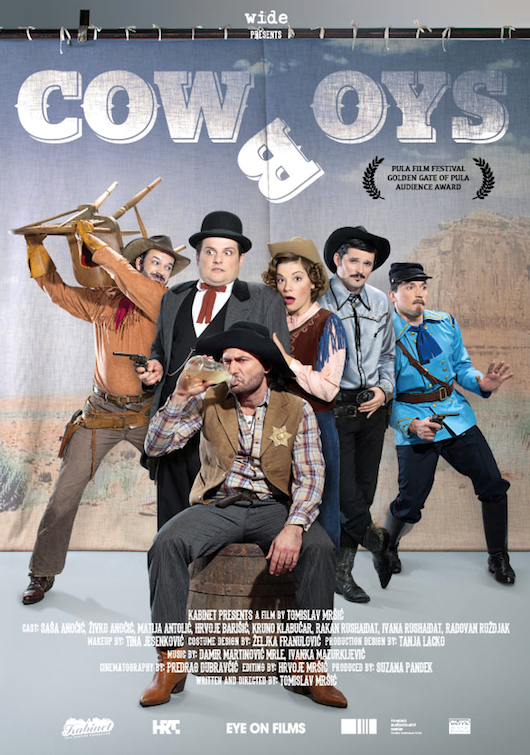
COWBOYS

'Cowboys' is an oddball absurdist Croatian comedy that was such a hit at home it became the country's official submission for an Academy Award Best Foreign Picture Nomination last year. It didn't win anything but it did at least show the world what extraordinary filmmakers they are, and what a glorious bizarre sense of humor they have that is a sheer treat.

Saša, a famous stage director suffering with cancer, returns to his small depressing industrial hometown where he is immediately press-ganged into putting on an amateur show for the culturally starved townsfolk. Only five eccentric and most unlikely people turn up for the auditions, and so by sheer default that become what Saša aptly calls his 'idiots'. They include a silent deeply closeted gay man, an overly keen mama's boy/postal worker, a street vendor trying to avoid the loan sharks who want their money repaid and a young woman who speaks in a language that none of them understand.  None of them have ever acted before in their lives.

When Saša tries to comb this unkempt and illiterate group for inspiration as to what they should perform he draws a blank as none of them have any cultural references at all. The only thing that they seem to be able to relate too are cowboys, so Saša resolves to mount a musical western. He bravely ensures that the production is more than a touch avant-garde having his limited cast playing all the human parts and the animals too.

As the rehearsals get underway each of the crew seems to have either a major personal problem or just simply cold-feet so Saša has them all sing out a chant about not accepting 'I can't' under any circumstances.  He meanwhile is battling the return of his cancer which may limit him physically and give him a valid reason to lose his rag occasionally, but doesn't dampen his enthusiasm for the project.

The movie written by Saša Anonic, who also stars as Saša too, is based on his own very successful stage play and has its fair share of local jokes which get somewhat lost in translation and account for the fact that at 108 minutes is at least a half an hour too long. Having said that there is a delightful soundtrack of cowboy songs, and the rather wonderful uplifting ending, albeit tinged with sadness, is well worth the wait.

If this outlandish black comedy is atypical of Croatian cinema, then it is definitely a genre the world needs to see more.  It is something of an acquired taste but if you like somewhat ludicrous oddball movies, then it's a taste you will want to experience.

★★★★★★★★

CLOUDS OF SILS MARIA

Actress Maria Enders a 40-ish movie star is having something of a middle-aged crisis with her marriage dissolving and her career at a crossroads.  She has been persuaded to travel to Switzerland to accept an Award on behalf of her close friend the playwright Wilhelm Melchior who had given her the breakthrough role that started her career decades ago.  En route she gets a message that he has suddenly died, and soon after learns that to mark his passing there will be a theatrical staging of his celebrated movie 'Maloja Snake' that had made Maria a star. This time however they do not want her to recreate her original role of the young woman but play the part of a burned out older businesswoman who is manipulated by a young female assistant in a daring lesbian dynamic.

It's not something that Maria is keen to undertake as that would mean acknowledging that she is too old to play the part she really identifies with, but also there is bad omen that still remains about the role of the bitter older woman as the original actress had died in a tragic accident soon after the movie was released.

Whenever it suits her, Maria tends to shield herself from the outside world behind Val who acts as her personal assistant, confidante, minder, unofficial therapist and her rehearsal partner.  It is Val who persuades her reluctant boss to accept the stage role and even drags her to a nearby cinema to show Maria a rather appalling movie starring the hot young actress who will be playing the part in the play that Maria still covets. The fact that the ingenue has a infamous Lindsay Lohan type reputation in the media just serves to remind Maria of her own wild times which she had reluctantly left in her past. 

Marie's almost total dependency on Val almost burns her young assistant out and just when there is a hint of some physicality between the two, Val drives off into the night for a date with a boyfriend that she had strangely failed to mention any time prior.Then soon after this she completely disappears somewhat mysteriously when the mists of the clouds high up in the mountains engulf both women, and she is never seen again.

Juliette Binoche brings this rather disturbing plot completely alive with an outstanding and impeccable performance as Maria.  It is on one level a case of art mirroring life, as Ms Binoche got her first big break almost 30 years ago in 'Rendez-vous' written by Oliver Assayas who has now directed her in 'Sils Maria'.  A very impressive Kristen Stewart played Val with such veracity that it earned her a Best Actress César: an extremely rare honor for a non French actor, and Chloë Grace Moretz played Maria's bete noir.

It is very much a thought-provoking piece that gets a tad esoteric at times as Maria struggles to verbalise her own unsettled state.  It takes a brave actress to undertake a role which shows her rather exposed, racked with fear and such uncertainty but luckily for us Ms Binoche is totally fearless.

★★★★★★★★